
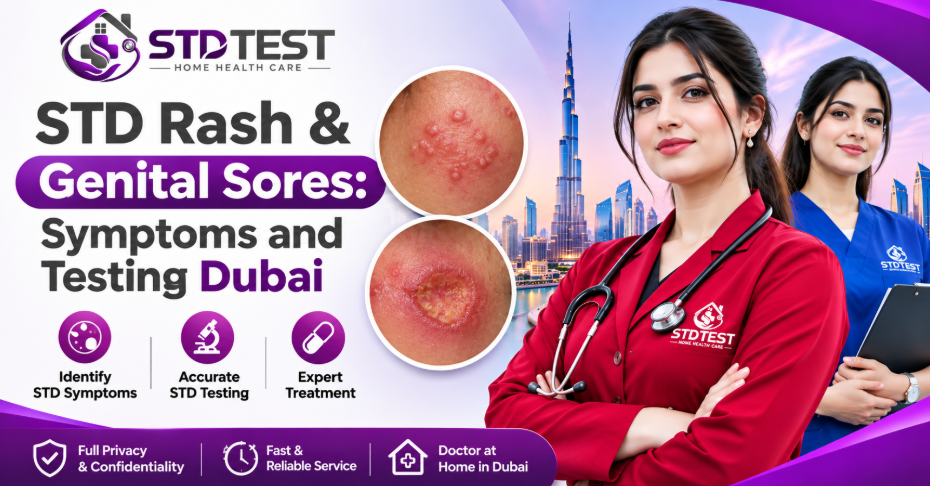
A genital rash, unexplained sore, fluid-filled blister, or new skin growth after sexual contact may indicate a sexually transmitted infection (STI), but many non-sexual conditions cause similar symptoms. Genital herpes, syphilis, and human papillomavirus (HPV) can affect the skin or mucous membranes, while other infections may cause fever, fatigue, urinary symptoms, or irritation without visible sores.
The safest way to identify the cause is a medical assessment supported by the correct laboratory tests. Patients in Dubai can contact STD TEST Clinic to discuss private STI testing, appropriate sample collection, and home doctor consultation where clinically suitable.
Recognizing STD Skin Symptoms
STI-related skin symptoms vary according to the infection and cannot be diagnosed reliably from appearance alone. Painful blisters may suggest herpes, a painless ulcer may raise concern for syphilis, and raised genital growths may be associated with HPV.
| Symptom | Possible cause | Recommended assessment |
| Painful genital blisters | Genital herpes | HSV PCR swab from a fresh lesion |
| Single painless genital ulcer | Primary syphilis | Syphilis blood tests and lesion assessment |
| Rash on palms and soles | Secondary syphilis | Syphilis serology and examination |
| Raised genital growths | HPV genital warts | Clinical examination |
| Genital redness after friction | Irritation or dermatitis | Examination if persistent |
| Fever and rash after HIV exposure | Acute HIV or another illness | HIV Ag/Ab test and possibly HIV RNA |
| Recurrent genital itching | Yeast infection, dermatitis, or another cause | Targeted examination and testing |
Several conditions can coexist, so identifying one explanation does not automatically exclude another infection. A patient with genital sores may also require HIV, syphilis, gonorrhea, or chlamydia screening based on their sexual history and clinical findings.
Can Skin-to-Skin Contact Transmit HPV?
HPV can spread through intimate genital skin-to-skin contact, including contact that does not involve penetrative intercourse. Vaginal, anal, and oral sexual activity can transmit HPV, and a person may pass the virus to a partner without visible warts.
Genital warts commonly appear as small, flat, raised, or cauliflower-like growths around the genital or anal area. They may be painless, itchy, or uncomfortable, and can develop months or even years after HPV acquisition.
A visible genital wart does not establish when the infection was acquired or which partner transmitted it. HPV can remain unnoticed for long periods, so the appearance of a new wart should not be interpreted as proof of recent exposure.
Genital warts are usually diagnosed through a clinical examination rather than an HPV blood test. A biopsy may be necessary for unusual, bleeding, ulcerated, pigmented, or uncertain lesions.
Treatment can remove visible genital warts but does not directly eliminate the underlying HPV infection. A qualified clinician may recommend prescription topical treatment, cryotherapy, or another appropriate procedure depending on the location and size of the growths.
HPV vaccination helps prevent infections caused by selected HPV types but does not treat an existing infection. Condoms reduce transmission risk without providing complete protection against contact with uncovered skin.
Red Spots on Hands and Feet: Secondary Syphilis
A rash affecting the palms of the hands or soles of the feet can be a sign of secondary syphilis, particularly after a possible sexual exposure. However, allergic reactions, viral illnesses, inflammatory conditions, and other infections can produce similar skin changes.
Secondary syphilis may cause a rash that is not itchy and can appear as reddish, copper-colored, or brownish spots. Additional findings may include swollen lymph nodes, mouth lesions, patchy hair loss, fatigue, fever, or moist lesions around the genital or anal region.
Syphilis is caused by the bacterium Treponema pallidum and progresses through stages if it is not appropriately treated. The rash may disappear without treatment, but that does not mean the infection has been cured.
Diagnosis generally requires both a nontreponemal blood test, such as RPR or VDRL, and a treponemal test. A clinician interprets the results alongside symptoms, previous treatment history, and the timing of exposure.
Syphilis is treatable with appropriate antibiotics, but the treatment regimen depends on the disease stage and clinical circumstances. Benzathine penicillin G is a recommended treatment for many forms of syphilis, with dosing and duration determined by the diagnosis.
Patients with visual changes, hearing loss, severe headache, neurological symptoms, or suspected syphilis during pregnancy require prompt specialist assessment.
STD TEST Clinic can be contacted to discuss private syphilis testing and doctor consultation in Dubai.
Fluid-Filled Genital Blisters: Herpes Symptoms
Clusters of painful, fluid-filled blisters around the penis, vulva, anus, or surrounding skin may indicate genital herpes. Herpes simplex virus type 1 (HSV-1) and type 2 (HSV-2) can both cause genital infection.
A first recognized herpes outbreak may involve tingling, burning, itching, painful sores, or discomfort during urination. Some people also experience fever, swollen groin lymph nodes, and body aches.
A genital herpes outbreak may appear within days of infection, but symptoms can also develop much later or remain unnoticed. The timing of visible lesions alone cannot reliably determine when HSV was acquired.
A PCR or another validated NAAT swab from a fresh blister or ulcer is generally the preferred diagnostic test when an active lesion is present. Testing an old, healing lesion can be less sensitive, and a negative swab does not always exclude herpes.
Prescription antiviral medications such as acyclovir or valacyclovir can reduce symptoms and shorten outbreaks when used appropriately. They do not permanently eradicate HSV, and the decision to use episodic or suppressive therapy depends on the patient’s circumstances.
Avoid sexual contact during active lesions or warning symptoms. HSV can sometimes spread even when no sores are visible.
Patients with severe pain, difficulty urinating, extensive lesions, or herpes symptoms during pregnancy should seek prompt medical care.
Painless Genital Ulcers: Primary Syphilis
A painless ulcer on the penis, vulva, vagina, anus, or mouth can be a primary syphilis chancre. The lesion is often firm and round, but its appearance varies, and some syphilis sores are painful or difficult to notice.
A syphilis chancre commonly develops around three weeks after infection, although the incubation period can range from approximately 10 to 90 days. The ulcer may heal naturally within several weeks even if the infection remains untreated.
A disappearing genital sore does not mean syphilis has resolved. Without effective treatment, the infection can progress to later stages and potentially affect other organs.
Blood testing is essential when syphilis is suspected, although very early infection may initially produce negative results. A doctor may recommend repeat testing or direct lesion testing when available.
Herpes, traumatic ulcers, and other genital conditions can resemble a syphilis chancre. Patients should avoid self-diagnosis and arrange an examination while the lesion is still visible.
Early diagnosis allows the clinician to prescribe stage-appropriate treatment and arrange partner evaluation when necessary.
HIV and STD Transmission From Toilet Seats
HIV is not transmitted through ordinary contact with public toilet seats, hotel restroom surfaces, or shared bathroom facilities. HIV transmission requires specific infectious body fluids to reach a susceptible route of entry, such as mucous membranes, damaged tissue, or the bloodstream.
Genital herpes, syphilis, and HPV are not normally acquired by sitting on a public toilet seat. Their established transmission routes involve relevant intimate contact, and ordinary restroom use is not considered a meaningful sexual transmission exposure.
Touching a toilet seat does not create an indication for HIV PEP or routine STI testing by itself. A person who has had an actual sexual or blood exposure should instead be assessed according to that specific event.
Good restroom hygiene remains sensible for preventing common infections, even though routine toilet-seat contact is not a recognized HIV transmission route. Washing hands and keeping shared facilities clean are appropriate general precautions.
Patients who develop genital symptoms after using a public restroom should not automatically attribute them to the restroom. A medical assessment can identify more likely causes.
Fever, Night Sweats, and Fatigue After Risky Sex
Fever, night sweats, severe fatigue, sore throat, or a widespread rash approximately two weeks after a potential HIV exposure can occur during acute HIV infection. These symptoms are nonspecific and may also result from influenza, COVID-19, mononucleosis, or other illnesses.
Acute HIV symptoms often develop around two to four weeks after infection, although not everyone experiences a recognizable illness. The presence or absence of symptoms cannot confirm or exclude HIV.
A laboratory-based fourth-generation HIV antigen/antibody test and an HIV RNA test may be appropriate when acute HIV is suspected. HIV RNA testing can identify infection earlier than standard antibody-based tests in many cases.
A negative HIV test obtained too soon after exposure may require repeat testing. Laboratory fourth-generation tests generally have an 18–45-day detection window, while HIV nucleic acid tests can usually detect infection approximately 10–33 days after exposure in people who are not taking antiretroviral medication.
Patients who develop a flu-like illness after a significant HIV exposure should arrange prompt medical assessment instead of relying on symptoms or an early negative test. A clinician can assess the exposure, choose suitable investigations, and arrange follow-up.
HIV is treatable with antiretroviral therapy, and timely diagnosis allows earlier access to effective medical care.
HIV PEP After a Recent Exposure
HIV post-exposure prophylaxis (PEP) is an urgent preventive treatment that should be started as soon as possible and no later than 72 hours after a qualifying exposure. PEP is generally taken for 28 days under medical supervision.
PEP is intended to prevent HIV infection before it becomes established, not to treat symptoms that appear weeks after an exposure. A clinician determines whether PEP is indicated based on the type of contact, source status, and other clinical information.
Patients within the 72-hour window should seek immediate medical assessment rather than wait for an appointment or a laboratory result. If timely PEP assessment is unavailable through a home healthcare provider, an emergency department is the appropriate alternative.
STD TEST Clinic can be contacted for guidance on urgent HIV exposure assessment and available consultation arrangements in Dubai.
Blood in Urine After Unprotected Sex
Visible blood in urine after sexual contact requires prompt medical assessment because it is not a specific symptom of an STI. Urinary tract infections, kidney stones, urinary tract injury, inflammation, and other conditions may cause hematuria.
Gonorrhea or chlamydia can cause urethral inflammation and urinary discomfort, but blood in urine should not automatically be attributed to either infection. A clinician may recommend urinalysis, urine culture, STI NAAT testing, and additional investigations according to the findings.
Persistent or visible blood in urine should be evaluated even when there is no pain. The doctor may need to exclude urinary tract disorders unrelated to sexual exposure.
Blood in urine accompanied by fever, flank pain, vomiting, urinary retention, blood clots, or severe pain warrants urgent hospital assessment. These findings may indicate a condition requiring immediate investigation or treatment.
A home consultation may be appropriate for some stable patients, but emergency symptoms should never be delayed for routine sample collection.
Can UTI Antibiotics Cure an STI?
Antibiotics prescribed for a urinary tract infection do not necessarily treat gonorrhea, chlamydia, syphilis, or other STIs. Different infections require different medications, doses, routes, and treatment durations.
Common UTI treatments such as nitrofurantoin are not appropriate substitutes for recommended gonorrhea or chlamydia treatment. Taking an antibiotic without identifying the infection can temporarily alter symptoms while leaving the underlying problem unresolved.
Burning urination following sexual contact may be caused by a UTI, an STI, or both. A urine culture can investigate bacterial urinary infection, while gonorrhea and chlamydia are generally diagnosed using NAAT testing.
A standard urine culture does not reliably rule out gonorrhea or chlamydia. Patients should tell their clinician about recent sexual exposure so that appropriate tests can be requested.
Treatment should follow a clinical diagnosis or a justified presumptive-treatment decision. Gonorrhea management is particularly important because antibiotic resistance affects treatment selection.
Avoid using leftover antibiotics or combining medications without professional advice.
Recurring Yeast Infections and Hidden STIs
Repeated vaginal itching, redness, or discharge may result from recurrent vulvovaginal candidiasis, but symptoms can overlap with other vaginal infections. Bacterial vaginosis, trichomoniasis, contact dermatitis, and inflammatory conditions can cause similar complaints.
Recurrent vulvovaginal candidiasis is commonly defined as three or more symptomatic episodes within one year. It can be associated with antibiotic exposure, diabetes, immune-related factors, or Candida species that respond differently to standard treatment.
A yeast infection is not generally classified as a sexually transmitted infection. However, having recurring symptoms does not exclude the possibility of a separate STI.
Persistent symptoms after antifungal treatment should be investigated rather than repeatedly treated without confirmation. Vaginal microscopy, fungal culture, or other validated testing may help identify the organism and determine whether additional STI screening is appropriate.
A clinician may recommend trichomoniasis, gonorrhea, or chlamydia testing when symptoms and sexual history support it. Testing decisions should be individualized rather than based on the assumption that every recurring yeast infection is sexually transmitted.
Longer or different antifungal treatment may be necessary for confirmed recurrent candidiasis. Treatment during pregnancy requires particular care.
Skin Irritation After Rough Sex vs an STD
Friction-related genital irritation often causes redness, tenderness, superficial abrasions, or burning shortly after prolonged or vigorous sexual activity. Inadequate lubrication, latex sensitivity, soaps, and scented products may contribute.
An STI becomes more concerning when symptoms include grouped blisters, persistent ulcers, unusual discharge, new genital growths, or a rash accompanied by systemic illness. However, infections and noninfectious irritation can overlap in appearance.
| Feature | More consistent with irritation | Requires STI consideration |
| Onset | During or soon after friction | Variable; days to months |
| Appearance | Diffuse redness or superficial abrasion | Blisters, ulcers, warts, or unexplained rash |
| Discharge | Usually absent | May occur with urethritis or cervicitis |
| Course | Often improves after avoiding irritation | May persist, recur, or change |
| Diagnosis | History and examination | Examination plus targeted testing |
Improvement after a few days does not conclusively rule out an STI. Some infections cause mild or temporary symptoms, and others remain asymptomatic.
Patients with persistent lesions, recurrent symptoms, or recent unprotected sexual exposure should seek clinical assessment. Avoid harsh antiseptics, steroid creams, and unprescribed genital treatments until the cause is understood.
Choosing the Right STI Test in Dubai
The appropriate STI test depends on the visible symptoms, anatomical site of exposure, and time since sexual contact. A single blood test or urine sample cannot diagnose every sexually transmitted infection.
A clinician may recommend:
- HSV lesion PCR: For fresh genital blisters or ulcers suspicious for herpes.
- Syphilis serology: For painless sores, suspicious rashes, or exposure to syphilis.
- HIV fourth-generation testing: For HIV screening after a relevant exposure.
- HIV RNA testing: When acute HIV infection is suspected or clinically indicated.
- Gonorrhea and chlamydia NAAT: For urinary symptoms, discharge, or exposure-based screening.
- Throat or rectal swabs: When the sexual exposure involved those anatomical sites.
- Vaginal swabs: For recurrent discharge, itching, or suspected vaginal infections.
- Clinical examination: For suspected genital warts or noninfectious skin conditions.
Testing immediately after exposure can be appropriate for symptoms or baseline assessment, but some infections require repeat testing after their detection window. A clinician should explain whether an early negative result is conclusive.
Genital warts are generally diagnosed visually, and routine HPV testing is not recommended for diagnosing visible warts. Cervical HPV screening serves a different clinical purpose.
Private STD Testing and Home Doctor Services in Dubai
A private home doctor consultation may be suitable for patients who need an initial assessment of genital symptoms or guidance about STI screening. The clinician can review the exposure history, evaluate symptoms where appropriate, and determine which tests or referrals are required.
STD TEST Clinic provides a contact point for patients seeking private sexual health services in Dubai. Patients can enquire about home doctor attendance, laboratory sample collection, prescription consultation, and follow-up arrangements according to the clinic’s confirmed services.
Home-based assessment can be especially convenient for suitable patients in Dubai Marina, JBR, Palm Jumeirah, Downtown Dubai, Business Bay, Jumeirah, Dubai Hills Estate, Arabian Ranches, and DAMAC Hills. Appointment availability, specimen handling, clinician qualifications, and fees should be confirmed when booking.
A qualified doctor may prescribe treatment when the diagnosis and clinical circumstances justify it. Certain conditions require a specialist examination, injectable treatment, a medical procedure, or hospital-based investigation rather than a routine home visit.
Confidentiality should be discussed with the healthcare provider before booking, including how records, laboratory results, and communications are handled. Healthcare services must follow applicable UAE requirements for medical documentation, privacy, and reporting.
When to Seek Emergency Medical Care
Emergency medical assessment is necessary when genital or urinary symptoms are accompanied by signs of serious illness. Severe pain, inability to urinate, rapidly spreading infection, significant bleeding, or neurological symptoms should not be managed solely through online advice.
Sudden severe testicular pain, severe pelvic pain with possible pregnancy, or fever with marked deterioration requires immediate hospital evaluation. These symptoms may indicate time-sensitive conditions unrelated to, or complicated by, an STI.
A possible HIV exposure within 72 hours also requires urgent assessment for PEP eligibility. Waiting for an ordinary appointment can reduce the opportunity for effective prevention.
Protecting Yourself and Your Partner
Consistent condom use, HPV vaccination, hepatitis B vaccination, and appropriate STI screening can reduce the risk of sexually transmitted infections. No single preventive measure eliminates every risk.
Sexual partners may need testing, treatment, or notification depending on the diagnosed infection. A clinician can explain the relevant guidance without assuming that a positive result proves recent transmission.
Avoiding sexual contact during active genital sores and following infection-specific treatment advice helps reduce transmission. Some infections require a defined period after treatment before sexual activity resumes.
Regular screening remains important even when there are no symptoms. Testing frequency should reflect individual exposure patterns and clinical recommendations.
Book an STD Consultation in Dubai
New genital sores, blisters, unusual skin growths, persistent itching, or unexplained rashes deserve accurate medical assessment rather than self-diagnosis. Early evaluation can identify treatable infections, reduce unnecessary medication use, and help patients understand whether follow-up testing is needed.
STD TEST Clinic can be contacted to discuss private STI testing and home doctor consultation options in Dubai. Suitable services may include clinical assessment, laboratory investigations, treatment planning, and follow-up when available and medically appropriate.
Visit STD TEST Clinic to enquire about appointment availability and the next appropriate step for your symptoms.